
The following is a lecture given at Manchester Metropolitan University in December 2023, written for the Level 4 unit Introduction to Modern Philosophy.
CONTENT WARNING: The following post contains themes of suicide which some readers may find distressing. If these themes affect you in any way, you will find details of support services at the end of the blog post.
We have studied some fascinating philosophers this term. We have explored Descartes’ rationalist philosophy and the rise of empiricism in the wake of the Age of Enlightenment. Each of these philosophers and their works has led us to challenge what we think we know about ourselves and the world. The question is, do you feel connected to the philosophies we have explored together? For example, how many of you were moved by our discussions of epistemological certainty? Has critiquing Cartesian metaphysics given you a new outlook on life? Even if we choose to ignore any practical application, were you able to relate to the philosophy in this unit? The works we have explored have their place in philosophical discourse, that is undeniable. However, I fear that they are intellectual to a fault.
Philosophers such as Descartes, Locke and Lovelace have an irrefutable influence in shaping our understanding of the mind, ethics, education and science to name a few disciplines. No-one is suggesting that these figures are unimportant. Yet, we have studied how we know what we know about the world, but not what it is to be part of that world. Our focus on metaphysics gives little engagement with how we are in the world as living, breathing things. Our lives are lived outside of our mind as much as within it.
Philosophies such as Locke’s have been applied to politics, challenging the inherent barbarism argued for by Hobbes. Descartes’ dualism has considerable ethical implications for us. Afterall, the intention of the Meditations was for them to be undertaken and practiced by the reader. And, of course, science needs a good metaphysics, he would argue, and this would lead to pragmatic uses for philosophy. Perhaps I am being too cynical. Maybe I should give Descartes more credit in this regard. Let me ask you this: how many of you have applied Descartes’ ideas to your own lives since starting this course?
Our discussions of sensation have revolved around sense data. Reliable or not, the senses present a world to us. Not only that, but we feel the world we exist in. However, the sense data of witnessing the funeral of a loved one seems to me to be more than just particles entering my eyes. I also feel the aching pain of grief buried deep in my chest. Something happens to me. When I cast the first fistful of dirt onto the coffin, it matters little to me whether I am deceived. Our experiences are important primarily because of what they do to us, not because of what they teach us. Understanding our experience of the world and the way the world affects us can teach us a lot about the ways we can live in that world. I believe finding a way to live a good life is a priority for many of us.
Given that we are a part of the world affecting us, we should consider carefully how we live within it. I want to argue that philosophy should be a practical tool for the cultivation of the self and the enhancement of life. To do this we need to think on how the world affects us and how we allow ourselves to be affected. What affects can we control? How might that change what we get from the world? In the past, others have committed to practices such as these and discovered happiness, flourishing, and calm. The pursuit of these ways of existing, I would argue, are of greater importance to us than deceptive demons. What about a philosophy we can use? Philosophy as a practice? Philosophy as a way of life?
One such philosophy is that of Arthur Schopenhauer. As a young man in Danzig, his father had asked that, before he committed himself to academia, he first travel with him on his merchant ship. Schopenhauer agreed and they set sail to a number of trading ports. As he travelled, Schopenhauer was taken aback by the variety and depths of suffering experienced by individuals all across the world. He was deeply moved with compassion and was resolved to use his academic ability to determine the cause of this suffering and a way to put an end to it. Schopenhauer was charmed by the ‘Upanishads’ which he described as “the production of the highest human wisdom”. Buddhism and Indology played a significant role in his approach to the cycles of suffering in the world. Through these ancient religions, he found the source of evil in our world.
Schopenhauer was writing at a time when philosophy was quickly losing its focus as a practical discipline and was becoming more academic. He had always held a healthy suspicion of academia, teaching subjects radically different to others during his lectureship at the University of Berlin from 1820. In particular, his lectures were markedly different to those of the most distinguished member of the faculty at that time: Hegel. This led to an academic battle of opposing ideologies. Schopenhauer held his lectures at the same time as Hegel, hoping to pull students away from him and his ideas. What actually happened was Schopenhauer facing empty lecture halls, as all his students had decided to attend Hegel’s lecture instead. This and other incidents within the university eventually drove Arthur away from academia altogether. Although he had tried and failed to establish a lecturing career for himself in Berlin, he was contemptuous of university philosophy. Schopenhauer was disappointed in academic philosophy for falling under the influence of the likes of Hegel, Fichte and other German idealists.
What is it that marks Schopenhauer as so different from his contemporaries? Our existence and experiences are central to Schopenhauer’s philosophical system. Much of what he says resonates with readers because we relate to it. We can identify with the accounts of the suffering in the world because we have all suffered pain, sorrow, grief and hardship in some form or another. We understand what it is to feel the enjoyment of something slipping into boredom and once again into the difficult pursuit of happiness. A large part of our suffering is in our pursuit of higher and higher pleasures, such as flavourful food. Rabbits will happily eat their own droppings, while we sample gourmet delicacies. We increase the amount of suffering when we search for greater pleasures. Seasoning is the enemy. In all seriousness, even our capacity to think has grown beyond that of other animals and, as such, causes us misery.
[…] the measure of suffering increases in man far more than the enjoyment, and it is very greatly enhanced specifically by the fact that he actually knows of death, while the animal only instinctively flees it without actually knowing of it and therefore without ever really having it in view, which man does all the time.
(Essays & Aphorisms (EA), 45)1
We contemplate the past and future more than any other creature and with far greater depth. As such, think too long on our death and grow fearful of it. The search for pleasure becomes even more intense in the knowledge that the opportunity to do so will one day come to an end.
Our life in this world is cruel and painful, Schopenhauer argues. We are doomed to endure toil and struggle. He suggests we start being honest about the insufferable reality of existence. ‘For to him who does know, children can sometimes seem like innocent delinquents, sentenced not to death but to life, who have not yet discovered what their punishment will consist of.’ (EA, 47) Better to rip the plaster off, as it were, and face the harsh reality of existence. After we can be candid about life, we can learn how to respond to it. We have the symptom, so what is the cause?
Schopenhauer had written his magnum opus, The World as Will and Representation, before he was 30 years old. The text contained his definition of the Will to Live. We may accept the statement “the world is my idea”, however we need to answer the question of the “my” – what possesses the idea, exactly? For Schopenhauer, the existence of the “I” is an absolute necessity. Once we understand the reality of “I” we can understand the reality of the wider world. We can know ourselves as a body. Now, when I say body I do not mean the meat and bones, as it were, but a body existing in a world of other bodies. Mine is a body which is affected by and affects other bodies. You will come to learn more about this interpretation of the body and the language used here when you read Spinoza, who greatly influenced Schopenhauer. Importantly, the body can be understood both objectively and subjectively. We learn a lot about ourselves through the ways we are affected by the world around us and what we want to find in the world. The things we want for ourselves from the world are our drives, that is our desires and wants. Those desires are manifestations of the Will.
The Will is the source of great pain in the world. We are not talking of will as the simple motivation to action. The Will is our fundamental, metaphysical reality. While I may be aware of the idea of the body, this is just an appearance. Underlying the idea or representation of my body (Vorstellung in German) is the thing-in-itself (Ding an sich) or the Will.
My body and my will are one.
(The World as Will and Representation (WWR), 102) 2
The Will is the metaphysical reality of all existing things, giving them their existence and providing us with the idea of them. The Will is the objective reality of all bodies, and the idea of them is the way the Will is understood by us. For example, while a rock exhibits seemingly different appearances when compared to my body, the same will in the rock is the will that exists in my body. Schopenhauer argues that we know this to be the case as we can see in the endless striving of all things for their continued existence the phenomenon of a striving and unfulfillable desire – the Will.
Why does Schopenhauer think the Will causes so much suffering? The Will, that metaphysical basis for existence, is characterised by a drive for preservation. Want, need, desire and lack are our experiences of the struggle for life found in the Will. Schopenhauer argues that our struggle for survival and the futile pursuit of happiness frames our experience of the world. Were we to find contentment and peace, we would quickly grow bored and restless. ‘One can even say that we require at all times a certain quantity of care or sorrow or want, as a ship requires ballast, in order to keep on a straight course.’ (EA, 43) As he writes in his essay “On the Vanity of Existence”: ‘Our existence has no foundation on which to rest except the transient present. […] Thus existence is typified by unrest’. The restless struggle through life is the momentum of that ceaseless Will. Like it or not, the Will has us chasing our desires in the vain hope of putting an end to our suffering. In his essay On the Suffering of the World, Schopenhauer gives us a brutal and candid evaluation of our existence in the worst of all possible worlds. ‘For the world is Hell, and men are on the one hand the tormented souls and on the other the devils in it.’ (EA, 48) Life is perpetual suffering, the heights of which exceed any pleasure we might find in it.
Schopenhauer is not telling us this for the sake of being maudlin or miserable. While his outlook is pessimistic, it is not without reason. A principle aim of Schopenhauer’s work is to ‘lift the veil of the Maya’, that is the illusory fog obscuring the truth of existence. He sees his work on the Will as exposing this truth to us so we can begin to consider the nature of existence and our own embodied life. Schopenhauer shares this with us in the hope that we will do something about the suffering in the world. For Schopenhauer, the Will is the source of suffering. The suffering within the world comes from our very being, that is it is ontologically determined by our consisting of the Will. Given that we are the Will and are therefore destined to suffer in pursuit of happiness from a metaphysical standpoint, how are we supposed to stop the inevitable? Schopenhauer provides us with a route to freedom from the Will and a freedom from the intolerable suffering it causes. Schopenhauer asks us to deny the Will to Live.
To many people, this sounds like he is advocating for suicide. While Schopenhauer was still young, his father ended his own life. Schopenhauer had sympathy with those who suffered like his father, which he shares these thoughts in his essay “On Suicide”. Indeed, Schopenhauer argued for suicide to be made legal, largely due to how appalled he was at the way individuals dying of suicide were perceived by the State and the Church (he bemoans England for having strict penalties against the estate of an individual believed to have taken their own life, for example disallowing a proper burial). Despite his acceptance of suicide as an understandable response to suffering, he did not condone it as a suitable way to deny the Will to Live. In his book The World as Will and Representation, Schopenhauer makes it clear that this is not the denial of the Will to Live. Rather, it affirms the Will to Live.
The suicide states to the world that they would have lived a little longer had the world not been so unkind to them. As such, the suicidal person aligns with the aims of the Will which desires a happy, contented life. Therefore, the Will to Live is affirmed in death by suicide. ‘The suicide wills life, and is dissatisfied merely with the conditions on which it has come to him.’ (WWR, 398) Suffering must be put to an end, but it cannot be in this way. Death by suicide does nothing to stop the Will.
The suicide denies merely the individual, not the species. We have already found that, since life is always certain to the will-to-live, and suffering is essential to life, suicide, or the arbitrary destruction of an individual phenomenon, is a quite futile and foolish act, for the thing-in-itself remains unaffected by it, just as the rainbow remains unmoved, however rapidly the drops may change which sustain it for the moment.
(WWR, p.399)
Rather than try in vain to stop the will in this way, bemoaning its sorrows, we ought to shun the real cause of suffering: desire. Schopenhauer proposes that the individual most successful at denying the Will to Live is the ascetic. The ascetic denies the world through a life of solitude and abstinence. What does this look like in practice?
An unavoidable experience in life is the witnessing of the suffering of others. Often, when that happens, we see something of our own experience of suffering reflected back at us. In that instant, the suffering in the world is then discovered, recognised, acknowledged and felt through the lives of others, as well as ourselves. Schopenhauer calls this phenomenon mitleid, in English: compassion. The literal translation of mitleid is “suffering with” and he argues that those of us who are moved by the suffering of others feel compassion and are compelled to act to alleviate their suffering. For Schopenhauer, it is compassion which forms the basis of justice, virtue and the distinctions between good and evil. Yet, for a few people, there is a moment of realisation. They see the awful truth that their help can do nothing to permanently diminish the suffering in the world. These knowledgeable individuals understand that all action is futile if it does not deny the Will. They are the rare few who become the ascetics.
To deny the will to live, one needs to live an ascetic life. Examples of figures such as these include saints, mystics, gurus, Buddhist monks, yogis and other exceptional people Schopenhauer praises, who have chosen to deny desire in all its forms. Ascetics do this because they know there is no other way to stop suffering caused by desire, need and want.
If we compare life to a circular path of red-hot coals having a few cool places, a path that we have to run over incessantly, then the man entangled in delusion is comforted by the cool place on which he is just now standing, or which he sees near him, and sets out to run over the path. But the man who sees through the principium individuationis, […] is no longer susceptible of such consolation; he sees himself in all places simultaneously, and withdraws. His will turns about; it no longer affirms its own inner nature […] but denies it.
(WWR, p.380)
The Will ordinarily seeks to end suffering through desire fulfilment. However, by exercising the intellect and exposing the Will to the knowledge that suffering can only be stopped through denial, the ascetic turns the Will against itself. As a result, life is rejected as insufferable and its refutation is preferrable to the satiation of desire. Of course, the ascetic does not live a particularly pleasant life (though they would argue it is unpleasant to begin with), given that their aim is the mortification of the Will. The ascetic life is one of self-mortification, self-torture, and self-castigation, which whittles their Will to Live down to almost nothing. In death, their ‘last slender bond is now severed; for him who ends thus, the world has at the same time ended.’ (WWR, 382) Schopenhauer means this quite literally, as the end of the Will is the end of a metaphysical reality and all representations of it – literally nothing is left once the ascetic has died. The removal of the Will is the true end of suffering, even if it is only a small part of the totality of the Will that has ended.
Asceticism is brutal. The practice is exceptionally rare because it is so miserable. However, given the inevitability of suffering, Schopenhauer argues that you should interpret suffering as fuel for denying the Will to Live. Using your intellect, you can empower yourself by rejecting worldly things and attempt to end the suffering in the world. Temptation to submit to desire is always a threat, even for those saints who routinely avoid it. Therefore, Asceticism is not a goal so much as it is an ongoing practice in self-control, temperance and abstinence. As this approach seems so inaccessible, we may think this leaves us with no real route to easing our suffering, never mind escaping it. And yet, there is something which we can access through things such as art, nature and music. A window to a world where the Will is silenced. A something which dissolves the self into nothingness. This “something” is the sublime.
The sublime transports us into a Will-less existence. We find the concept detailed in Immanuel Kant’s Critique of Judgement. Kant describes the sublime as an experience that goes beyond the power of the imagination and enters the incomprehensible. We experience the sublime when confronted with the immeasurable enormity of infinity (Critique of Pure Judgement (CJ), §25)3 or feel a primal fear at the force of nature while safe enough to look upon its fury (CJ, §28). To Schopenhauer, the sublime frees our intellect from the striving of the Will (WWR, §38). Confronted with something such as the majesty or beauty of nature or a moving work of art or music, we are thrown from an existence of Willing to simply the possession of knowing.
When, however, an external cause or inward disposition suddenly raises us out of the endless stream of willing, and snatches knowledge from the thraldom of the will, the attention is now no longer directed to the motive of willing, but comprehends things free from their relation to the will.
(WWR, p.196)
Schopenhauer compares this state of tranquillity to that sought after by the Ancient Epicureans, a psychic calm, an oasis of peace in a world of strife. We can achieve this state when we find ourselves deep in contemplation, dissociated from the objects around us, absorbed in indifference.
For at the moment when, torn from the will, we have given ourselves up to pure, will-less knowing, we have stepped into another world, so to speak, where everything that moves our will, and thus violently agitates us, no longer exists.
(WWR, p.197)
We do not need self-flagellation to relief us from suffering in this world. Although Schopenhauer would insist that our goal be to deny the Will to Live entirely, we have, through nature and art, some small way to gain a little respite, a brief pause, from the turbulence of life.
Let’s draw this to a close. For Schopenhauer, the world can be divided into the will and the idea. The Will is the metaphysical basis for all existence and appears to us as desire. The desire characteristic of the Will is the cause of great strife and pain in the world. Happiness is only ever a transitory negation of the all-pervading suffering intrinsic to life. To end suffering, Schopenhauer argues that we must reject the world through ascetic denial of the Will to Live. Few people are strong enough to do this, and even fewer are willing to. However, all of us can know something of this blissful escape if we find those sublime media that allow us to transcend the torments of the world.
How might you apply this philosophy in your own lives? For one thing, we can learn to recognise when others suffer and the value of being a kind, virtuous and compassionate individual. Understanding that our compassion comes from a place of well-meaning and a want to end suffering. Also, perhaps the next time you find yourself struggling against the slings and arrows of life, you might find some way to step back from it all and let yourself be lost in something sublime. A work of art. A good book. A walk in the countryside. A beautiful melody. Discover those things which give you a peaceful oasis in which you can recover and relax. I do want to leave you with these questions: is it really the right thing, to flee from the Will? Or is our Will something we can learn to accept, affirm even, as a part of what we are and then harness it for our own empowerment?
Bibliography
- Schopenhauer, A. (1970) Essays and Aphorisms. Translated from German by R.J. Hollingdale. Harmondsworth, England: Penguin Books. ↩︎
- Schopenhauer, A. (1969) The World as Will and Representation: Volume I. Translated from the German by E. J. Payne. New York: Dover Publications. ↩︎
- Kant, I. (1952; 2007) Critique of Judgement. Translated from the German by J. C. Meredith. Oxford: Oxford University Press. ↩︎
Further Reading
Janaway, C. (2002) Schopenhauer: A Very Short introduction. Oxford: Oxford University Press.
Janaway, C. (2003) Self and World in Schopenhauer’s Philosophy. Oxford: Oxford University Press.
Magee, B. (1988; 1997) The Philosophy of Schopenhauer, Oxford: Oxford University Press.
Schopenhauer, A. (2010) The Essential Schopenhauer: Key Selections from The World As Will and Representation and Other Works. Edited and translated from the German by W. Schirmacher. London: Harper Collins.
Support
If you are affected by any of the issues discussed in this blog entry, please visit the following links for help and guidance:
Samaritans | Every life lost to suicide is a tragedy | Here to listen
Get Help & Support With… | Campaign Against Living Miserably (CALM) (thecalmzone.net)
Depression Test – Free mental health tests from Mental Health America (mhanational.org)
Useful contacts – suicidal feelings – Mind
Andy’s Man Club | #ITSOKAYTOTALK | Andy’s Man Club (andysmanclub.co.uk)
If you feel that you are a danger to yourself, call the emergency services (UK: 999).
If you are struggling with thoughts of suicide, depression or other mental health concerns, consider calling the Samaritans on 116-123.
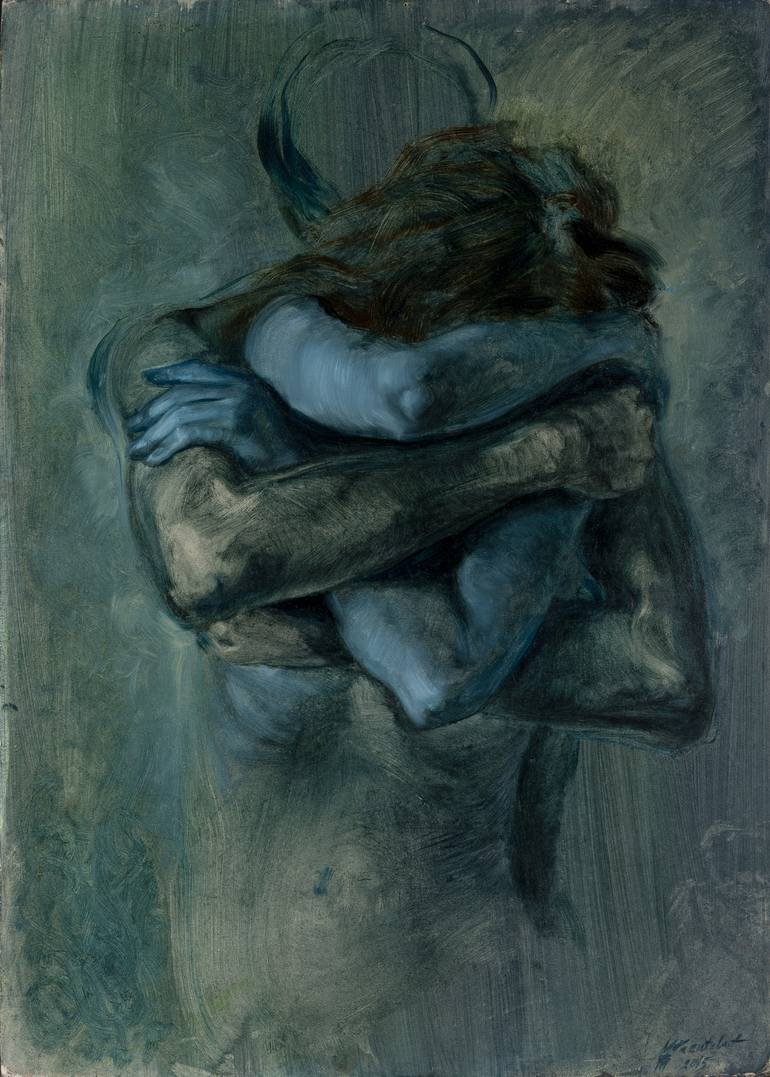
Featured Image: HUG painting by Marijana Rakićević
 Death and Happiness
Leave a comment